Excellent explanation — that’s a textbook‑level breakdown of how subtle pH variations influence retention time in HPLC. You’ve covered analyte ionization, silanol
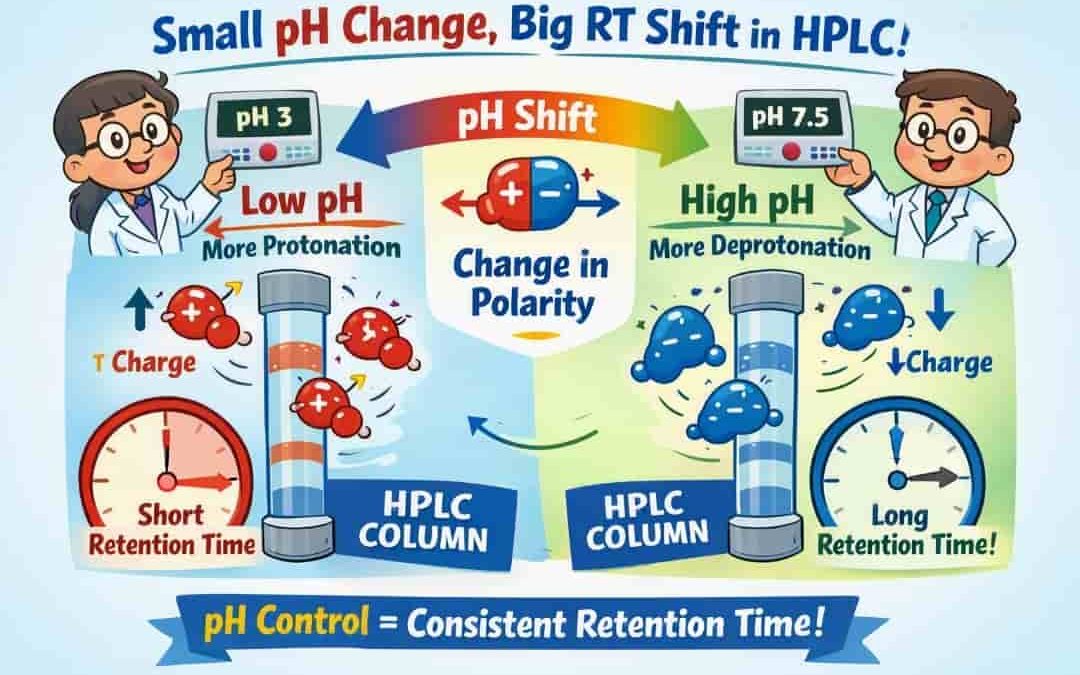
⚗️ Small pH change, big retention time shift in HPLC!
A minor pH tweak can drastically alter analyte and stationary phase ionization — shifting retention time Rand peak shape.
🔹 Analyte Ionization (pKₐ Sensitivity):
When mobile phase pH is within ±2 units of the analyte’s pKₐ, even a 0.1–0.2 pH change can flip the ionized/unionized ratio.
• Acids → higher pH → more ionized → t_R ↓
• Bases → higher pH → more neutral → t_R
🔹 Silanol Ionization:
Above pH 3.5, silica silanols deprotonate (Si–O⁻), creating cation‑exchange sites that trap basic analytes — causing longer retention and tailing.
🔹 Buffer Capacity:
Weak buffers (<10 mM) or mismatched pKₐ allow CO₂ absorption and solvent blending to drift pH, destabilizing retention.
✅ Best Practice:
Work ≥2 pH units away from analyte pKₐ and use buffers with pKₐ ≈ target pH ± 1.
HPLC #Chromatography #RetentionTime #pHControl #AnalyticalChemistry #PharmaScience #MethodDevelopment